
Headless AI workflow platforms let developers run image generation, video synthesis, and other AI tasks through APIs without managing GPUs or building frontend interfaces. Instead of clicking through a web app, you send a request to an endpoint and get results back programmatically. For teams shipping AI-powered products in 2026, choosing the right headless platform can cut integration time from weeks to hours. This guide compares six strong options across APIs, supported models, and pricing structures.
What Makes a Platform Headless
A headless AI workflow platform separates the execution engine from the user interface. You interact entirely through REST APIs, SDKs, or webhooks while the platform handles GPU provisioning, model loading, and scaling. This architecture is ideal for SaaS builders and automated content pipelines that need to generate images at scale.
Key traits to look for: API-first design with clear documentation, support for multiple model families (FLUX, Stable Diffusion, custom fine-tunes), pay-per-use pricing, cold start times under 5 seconds, and webhook callbacks for async jobs.
Replicate
Replicate offers one of the largest model libraries through a single API. You can run FLUX Pro, SDXL, LLaMA, Whisper, and thousands of community-uploaded models without provisioning infrastructure.
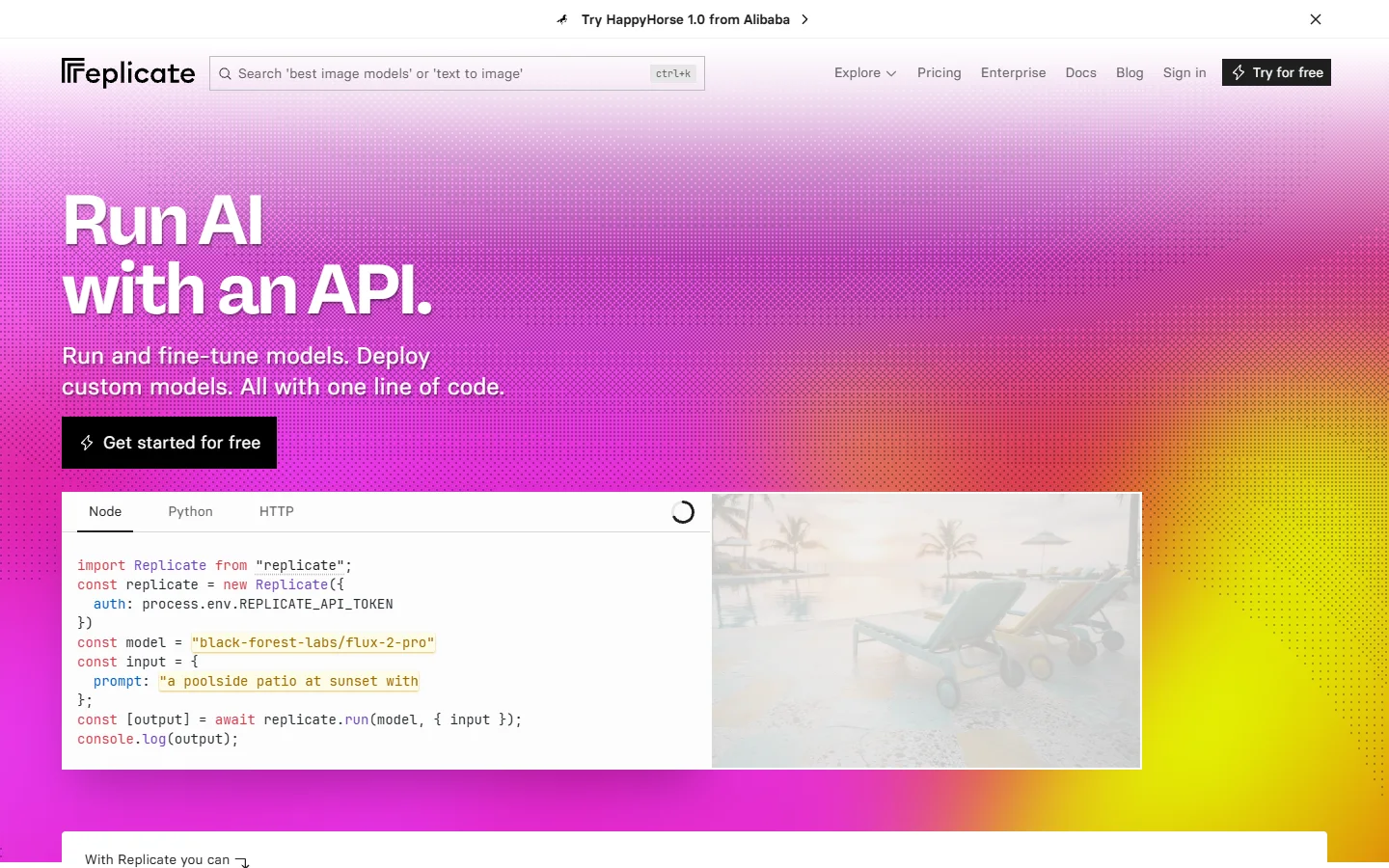
Their prediction API follows a simple pattern: create a prediction, poll or receive a webhook when it completes, download the output. Pricing is per-second of GPU time, roughly $0.01-0.03 per image for FLUX models. If you want to understand how API-based image pipelines work, Replicate is one of the easiest starting points. It supports custom models via Cog containers and has transparent per-second billing, but cold starts can hit 10-30 seconds on less popular models.
ComfyUI (Self-Hosted or Cloud)
ComfyUI is the open-source node-based workflow editor that has become the standard for advanced image generation. While it ships with a visual UI, the underlying execution engine is fully headless. You run workflows through its API by posting workflow JSON to the /prompt endpoint.
The power of ComfyUI in a headless context is workflow portability. Build a complex pipeline visually (FLUX model + ControlNet + upscaler + face fix), export it as JSON, then run it programmatically. Several cloud providers now offer hosted ComfyUI with API access. Self-hosting gives full control but requires GPU management. The community of custom nodes is massive, covering every major model family including FLUX, SD3, and custom LoRAs.

Fal.ai
Fal.ai has positioned itself as the fastest inference platform for generative AI, with cold start times in milliseconds for popular models. Their queue and streaming architecture lets you subscribe to generation progress via server-sent events, useful for production AI workflows that need real-time progress feedback in user-facing apps.
Pricing is competitive at $0.01-0.05 per generation depending on the model. They offer clean Python and JavaScript SDKs with strong FLUX model support. The model catalog is smaller than Replicate’s, but the platform’s speed advantage makes it a strong choice when latency matters.
Stability AI Platform
Stability AI offers its own models (Stable Diffusion 3, SDXL, Stable Video Diffusion) through a hosted API. If your workflow centers on the Stable Diffusion ecosystem, their first-party API gives you access to the latest model weights on release day.
The API covers text-to-image, image-to-image, inpainting, outpainting, and upscaling. You can start building for free through platforms that integrate Stability models alongside FLUX and other providers, giving you a single API surface for multiple model families. Pricing runs on a credit system with costs varying by model and resolution.

RunPod
RunPod takes a different approach: rather than pre-built model endpoints, RunPod gives you serverless GPU containers where you deploy your own inference code. You get a Docker container with GPU access and RunPod handles auto-scaling and request routing.
This makes RunPod the most flexible option but also the most hands-on. You containerize your inference code, handle model loading, and build your own API layer. For teams with a fine-tuned FLUX model and custom preprocessing, RunPod is often the most cost-effective choice, with competitive GPU pricing on A100, H100, and 4090 hardware. Community templates for common setups like ComfyUI and FLUX are available to speed up deployment.
Baseten
Baseten focuses on production model deployment with performance optimization. Their Truss framework packages any Python model into a deployable API endpoint with automatic GPU allocation and scaling.
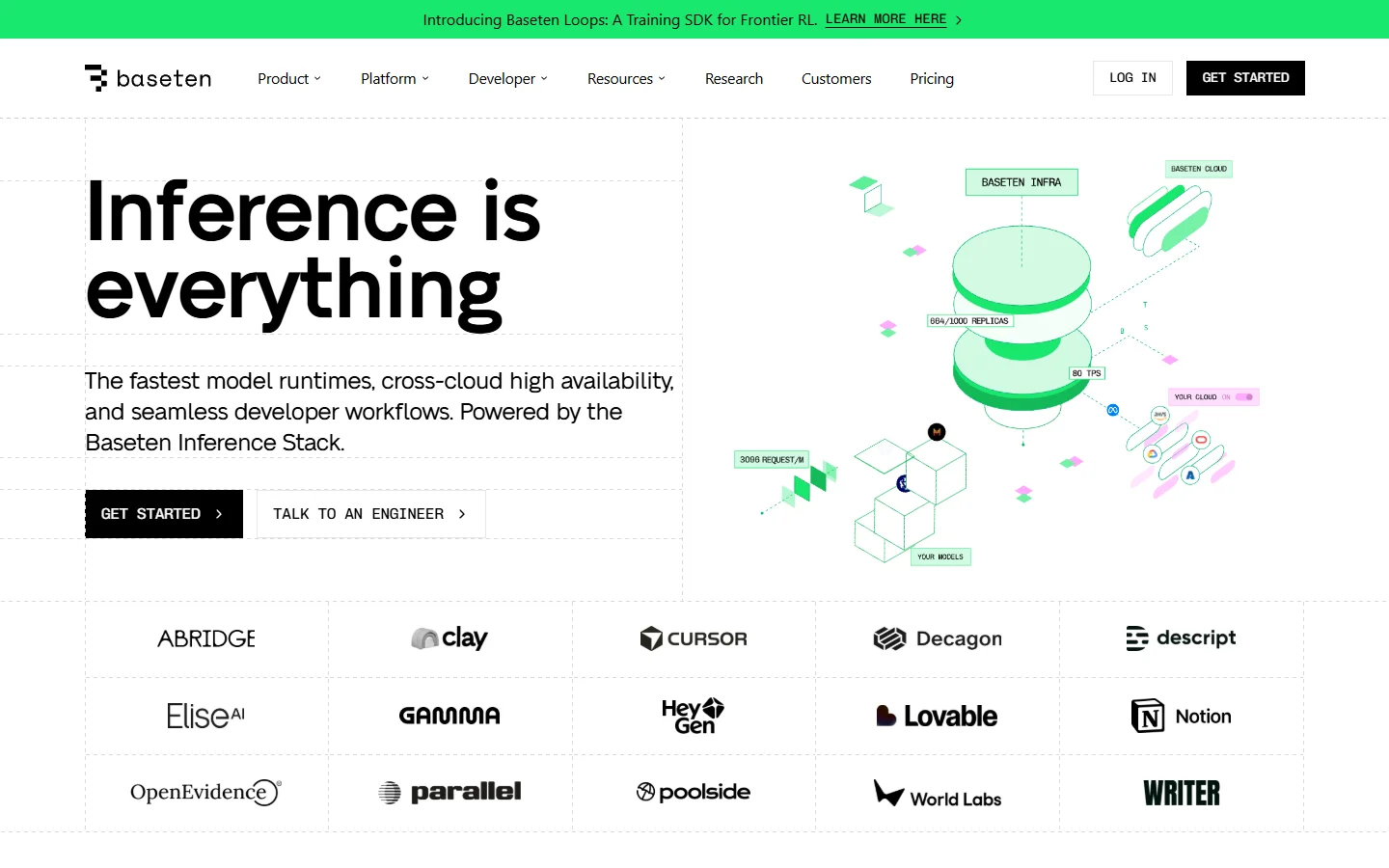
For image generation, Baseten offers pre-optimized deployments of FLUX and Stable Diffusion models you can spin up in minutes. Wireflow’s AI workflow platform takes a similar approach to multi-model orchestration, letting you chain different providers into a single pipeline through a visual canvas with full API access. Baseten includes built-in A/B testing and monitoring, though it has a smaller community compared to Replicate or RunPod.
How to Choose
| Platform | Best For | Cold Start | Pricing Model |
|---|---|---|---|
| Replicate | Broadest model selection | Medium | Per-second GPU |
| ComfyUI | Maximum pipeline control | Self-managed | Free (self-host) |
| Fal.ai | Lowest latency | Very fast | Per-generation |
| Stability AI | SD-native workflows | Fast | Credit-based |
| RunPod | Custom infrastructure | Configurable | Per-second GPU |
| Baseten | Production optimization | Fast | Per-second GPU |

Frequently Asked Questions
What is a headless AI workflow platform? A headless AI workflow platform provides AI model execution through APIs without requiring a graphical interface. You send requests programmatically and receive generated outputs like AI-generated images or video in response.
Which platform has the fastest FLUX inference? Fal.ai currently leads in cold start times and inference speed for FLUX models. Replicate and Baseten also offer competitive performance on warm instances.
Can I run custom fine-tuned models? Yes. Replicate supports custom models via Cog containers, RunPod lets you deploy any Docker container, Baseten uses the Truss framework, and ComfyUI supports custom LoRAs and checkpoints. For a broader look at how headless AI extends beyond image generation, this review of conversational AI agents covers adjacent use cases.
Is self-hosting ComfyUI better than a cloud API? It depends on volume and team skills. Self-hosting gives you full control and lower per-image costs at scale, but requires GPU procurement, maintenance, and scaling expertise. Cloud APIs eliminate infrastructure overhead.
How much does headless AI image generation cost? Typical costs range from $0.01 to $0.05 per image. RunPod and self-hosted ComfyUI can bring costs below $0.005 at scale but require upfront infrastructure work. Compare costs across different generation approaches to find the best fit for your budget.
What programming languages are supported? All platforms offer REST APIs, so any language with HTTP support works. Most provide official Python SDKs, and several also offer JavaScript/TypeScript SDKs for Node.js.
Do these platforms support video generation? Yes. Replicate, Fal.ai, and RunPod support video models like Stable Video Diffusion and AnimateDiff. ComfyUI supports video generation through community nodes.
Conclusion
The headless AI workflow space has matured significantly in 2026. Whether you need a quick API integration or a production pipeline processing thousands of generations per hour, there is a platform that fits. Start by identifying your priority: model variety (Replicate), speed (Fal.ai), control (ComfyUI/RunPod), or production tooling (Baseten).