
A Suno MCP server lets an AI assistant write lyrics, generate a track, and export the audio without anyone opening the Suno web app. Six servers are worth installing in 2026.
MCP, the Model Context Protocol, is the connector standard that Claude Code, Cursor, VS Code, and JetBrains AI Assistant all speak. A Suno MCP server wraps the Suno music API in that standard so your assistant can call it like any other tool. If you still generate tracks by hand, the roundup of AI music generators for content creators covers the manual side first.
What a Suno MCP server actually does
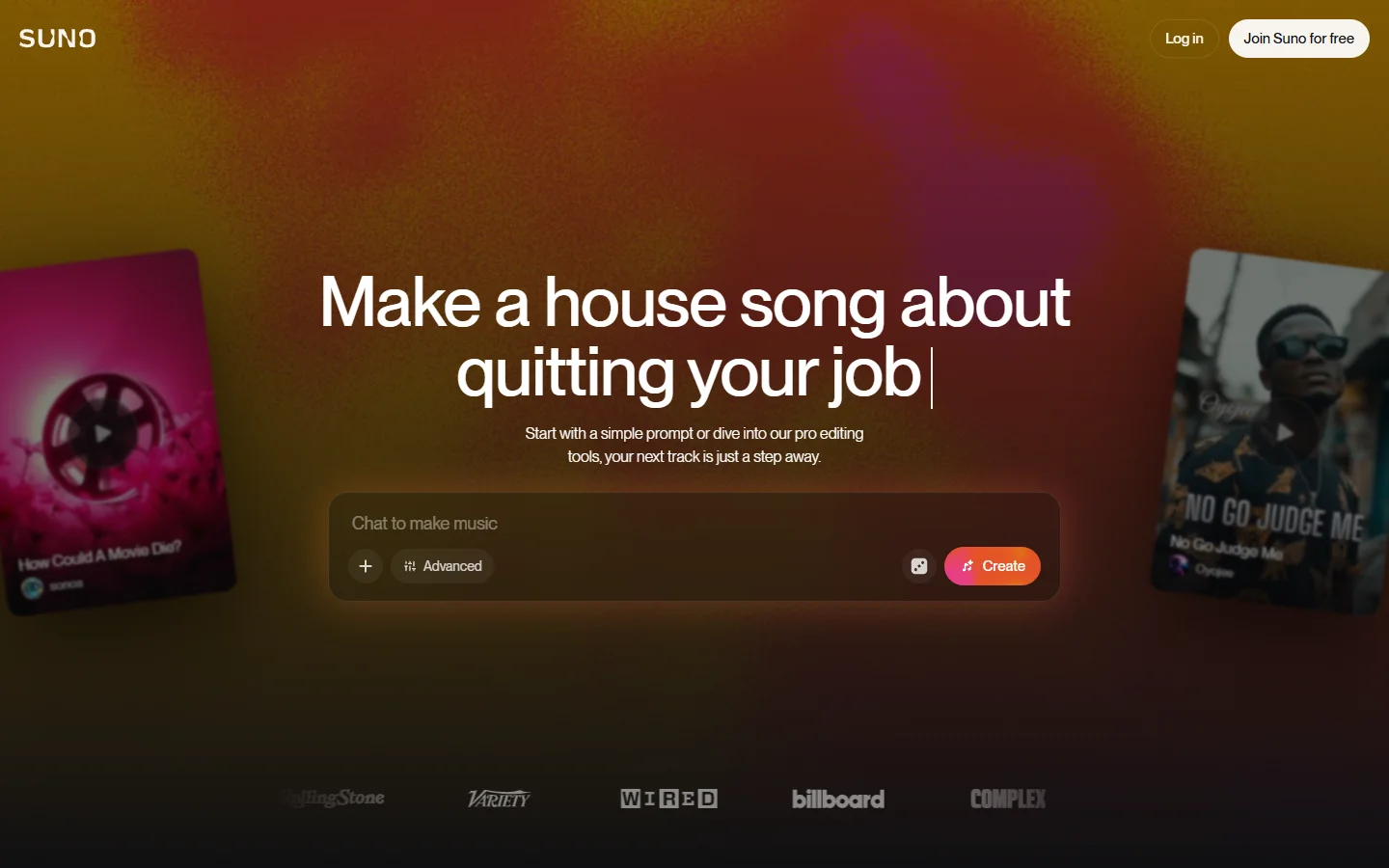
Suno is a text-to-music model. You describe a style, optionally supply lyrics, and it returns finished tracks with vocals. The hosted product at Suno sells this as a subscription: 50 credits per day free, 2,500 credits at $8 per month on Pro, and 10,000 credits at $24 per month on Premier, which is the same budget most people already spend on AI soundtracks for YouTube videos.
An MCP server adds three things on top. It exposes each Suno action as a named tool your assistant can call, it handles the async job polling that music generation requires, and it returns file URLs the next step can consume. The pattern matches this walkthrough of building AI workflows with an API, except the plumbing is already written.
Two things separate the good servers from the rest: how many Suno actions they expose beyond a basic generate call, and whether they bill through your existing Suno subscription or through a third-party API reseller. Both matter more than the install instructions.
The six Suno MCP servers worth using in 2026
Ranking criterion is tool coverage first, then setup friction, then how credits are billed. Every server below was checked against its public repository or listing in August 2026, using the same criteria applied to developer-friendly AI generation platforms.
1. AceDataCloud SunoMCP
AceDataCloud SunoMCP exposes 26 tools, the widest coverage on this list. Verdict: best for full production music workflows.
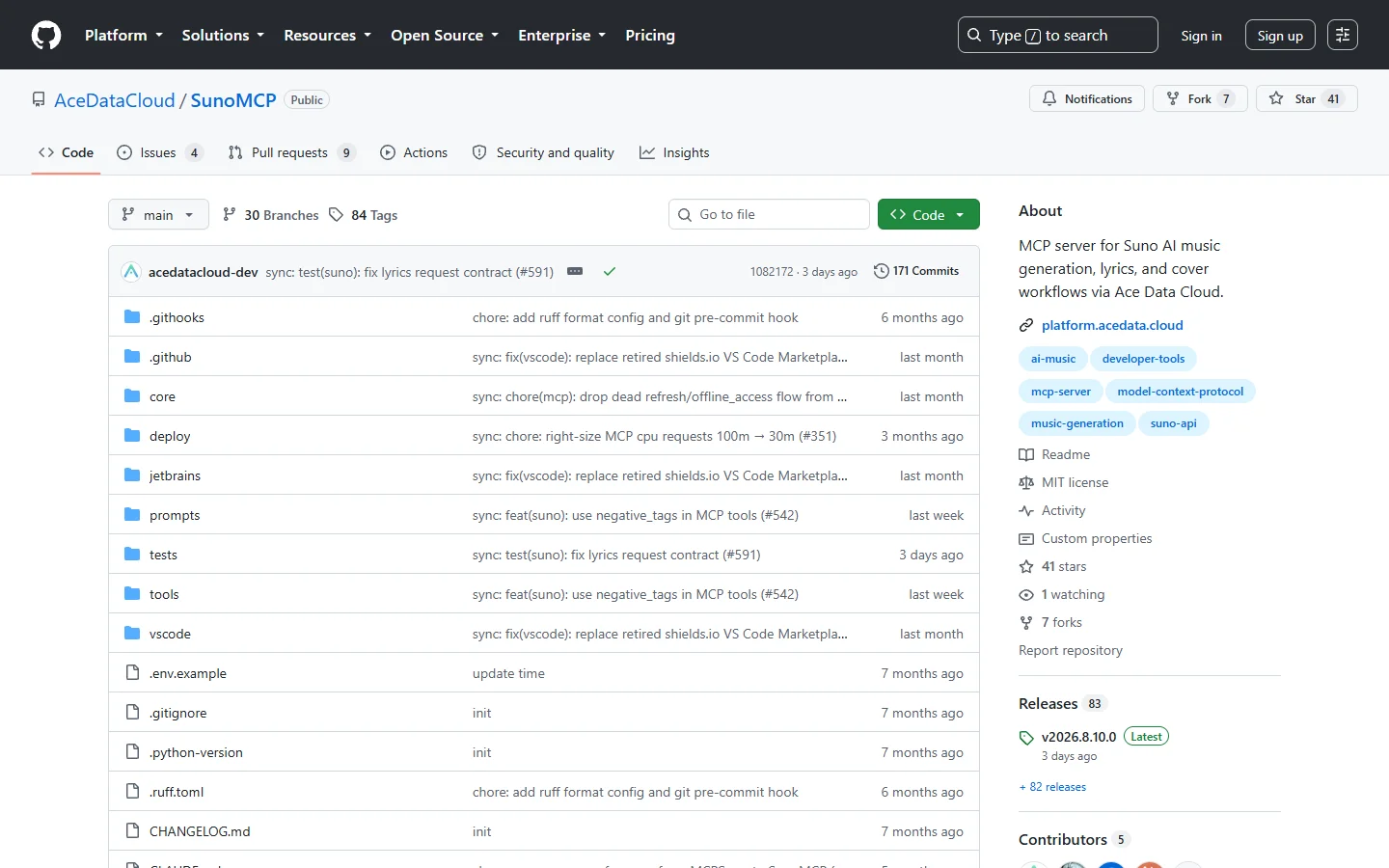
Beyond generate_music it covers extend_music, cover_music, mashup_music, replace_section, stems_music, extract_vocals, remaster_music, and persona creation, plus converters for MP4, WAV, MIDI, and timing data. Models run from chirp-v3.5 at 120 seconds to chirp-v5-5 at eight minutes, with vocal gender control from v4.5 up. That breadth is closer to a full audio API than a single endpoint, the same trend visible across AI content generation APIs.
Run it hosted at https://suno.mcp.acedata.cloud/mcp over streamable HTTP with a bearer token, or locally with pip install mcp-suno and an ACEDATACLOUD_API_TOKEN variable. The cost is that billing runs through Ace Data Cloud rather than your own Suno account.
2. RunAPI Suno MCP
RunAPI ships a 13 tool server with the cleanest install of the group, and it is the one to pick if you already work through an AI API with Claude Code integration. Verdict: best for Claude Code and Codex users.
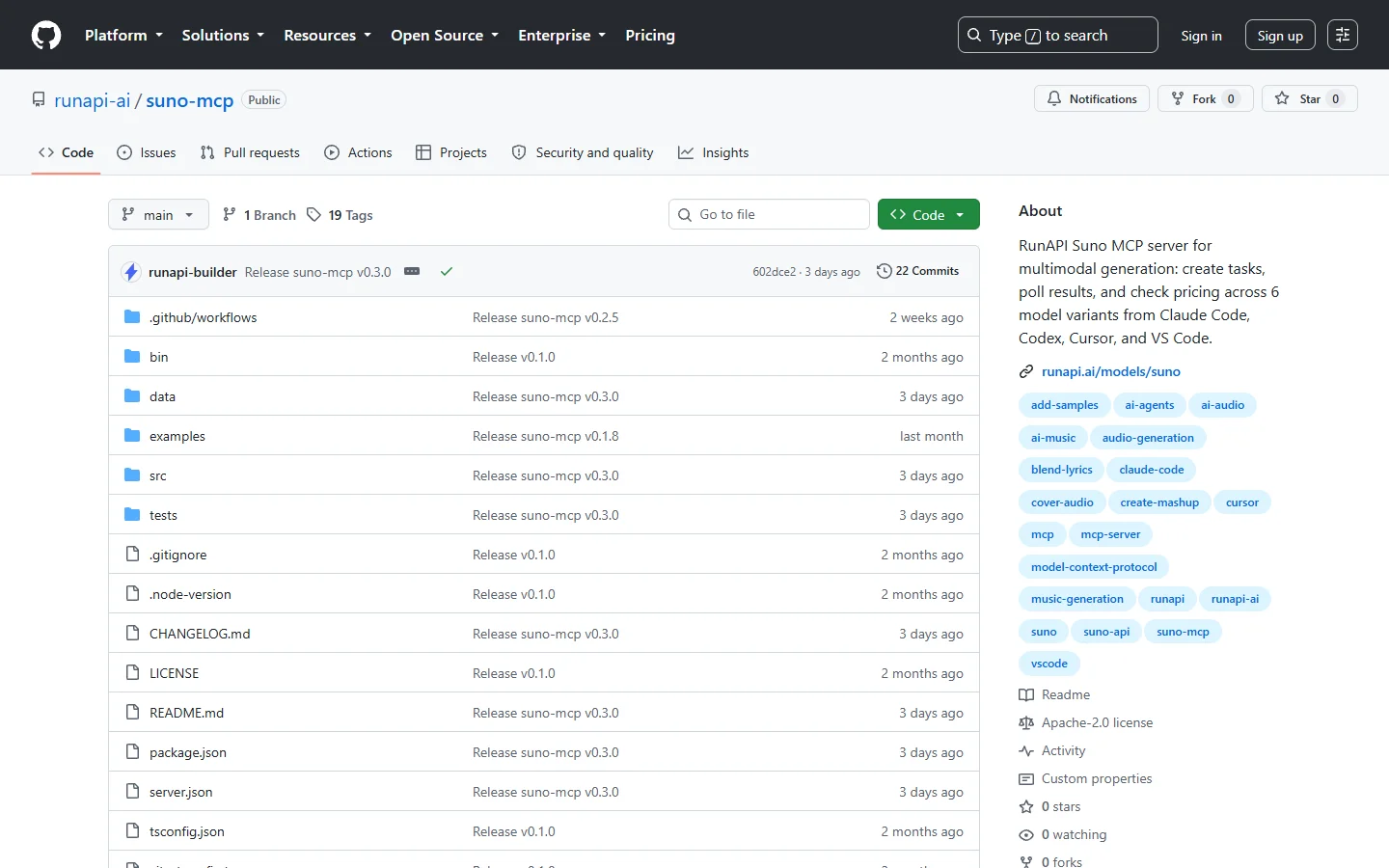
One command wires it up: claude mcp add suno -s user -- npx -y @runapi.ai/suno-mcp. Eleven creation tools cover text_to_music, text_to_sound, inspire_music, blend_lyrics, create_mashup, separate_audio_stems, stitch_audio, and remaster_audio, across six variants from suno-v4 to suno-v5.5. Note that text_to_sound only runs on v5 and v5.5.
The detail worth calling out is check_pricing, a tool that returns current per-model rates and needs no authentication. Being able to ask an assistant what a job costs before running it is rare, and it suits anyone tracking usage-based AI API pricing across a month.
3. Suno MCP for JetBrains IDEs
The Suno MCP plugin installs the MCP Suno server into JetBrains AI Assistant with 27 exposed tools. Verdict: best if you live in IntelliJ, PyCharm, or WebStorm.
It supports both transports, STDIO for a local process and HTTP for the remote endpoint, and setup is a marketplace install rather than a JSON config edit. Functionally it covers the same generate, extend, cover, remix, and mashup surface as the server it wraps, so pick it for the IDE integration rather than for unique capability, much as you would choose any AI API for developers on ergonomics.
4. suno-mcp session server
The suno-mcp package on PyPI takes the opposite approach to every other entry. Verdict: best if you already pay for Suno and do not want a second bill.
Instead of a reseller API, it drives a browser session authenticated against your own suno.com account through Clerk. Your assistant can check the credit balance, generate with a prompt and style, and download the finished MP3 against the subscription you already hold. The tradeoff is fragility, since session automation breaks whenever the front end changes. Treat it as the low-cost personal option, closer in spirit to building AI workflows without code.
5. CodeKeanu suno-mcp
CodeKeanu’s suno-mcp is the minimal self-hosted option, with six tools and a published Docker image. Verdict: best for a small, auditable deployment.
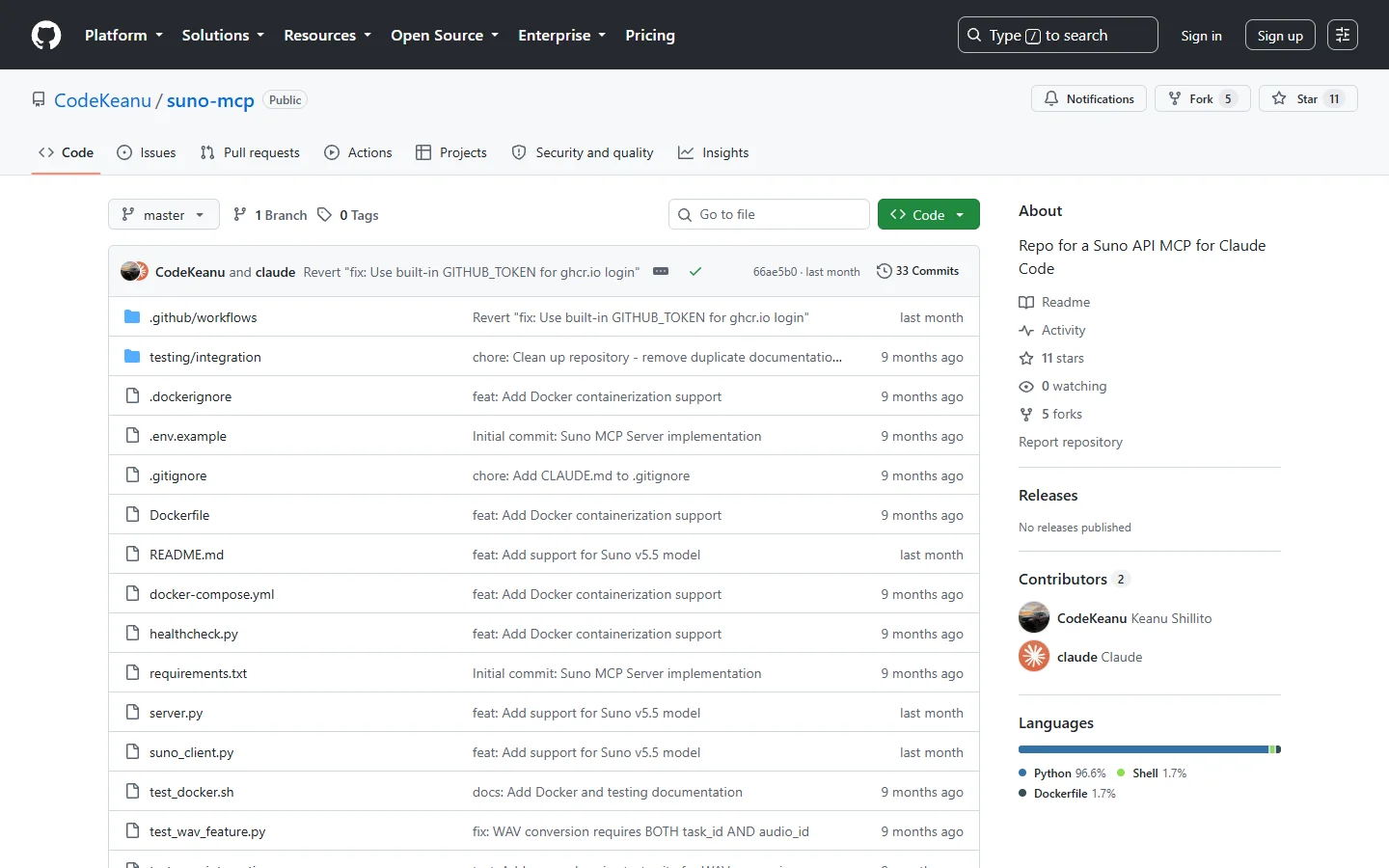
The tool set is deliberately short: generate_music, get_task_status, get_music_info, get_credits, convert_to_wav, and get_wav_conversion_status. It authenticates with one SUNO_API_KEY against api.sunoapi.org, supports v3.5 through v5.5, and pulls with docker pull ghcr.io/codekeanu/suno-mcp:latest. Each generation costs roughly 6 credits and returns two tracks, so pair it with an AI generation API with spend limits if you are automating volume.
6. viaSocket Suno MCP
viaSocket gives you a hosted MCP endpoint with authentication handled on their side. Verdict: best for no-code setups and non-developers.
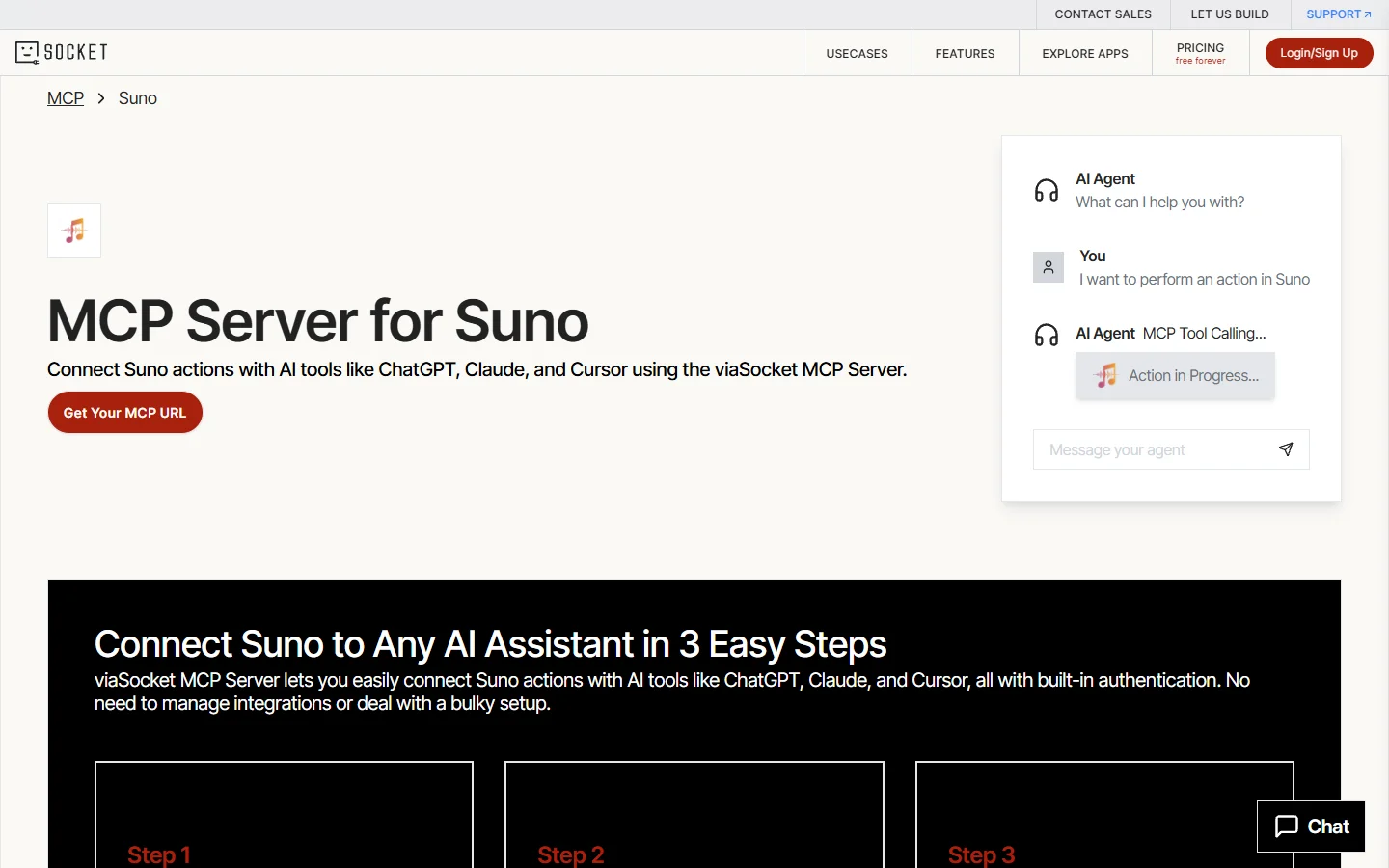
You pick the Suno actions you want, get a unique URL, and paste it into ChatGPT, Claude, or Cursor. viaSocket lists it as free indefinitely under a fair usage policy with no rate limits, plus a self-hosted enterprise tier. You configure actions in a dashboard rather than reading a repository, so the tool surface is less transparent than the open source options, a trade familiar from headless AI workflow platforms.
Comparison table
| Server | Tools | Models | Billing | Best for |
|---|---|---|---|---|
| AceDataCloud SunoMCP | 26 | chirp-v3.5 to chirp-v5-5 | Ace Data Cloud token | Full production workflows |
| RunAPI Suno MCP | 13 | suno-v4 to suno-v5.5 | RunAPI key | Claude Code and Codex |
| JetBrains Suno MCP | 27 | chirp-v3.5 to chirp-v5-5 | Ace Data Cloud token | JetBrains IDE users |
| suno-mcp session server | Core set | Your account’s models | Your Suno subscription | Personal projects |
| CodeKeanu suno-mcp | 6 | v3.5 to v5.5 | sunoapi.org key | Minimal self-hosting |
| viaSocket Suno MCP | Configurable | Provider default | Free, fair usage | No-code setups |
How to install one in five minutes
The fastest path is RunAPI in Claude Code. Run claude mcp add suno -s user -- npx -y @runapi.ai/suno-mcp, set RUNAPI_API_KEY in your environment, restart the client, then ask the assistant to call check_pricing to confirm the connection. Batch jobs behave like the queues described in running batch generation via API.
Three practical notes. Generation is async, so let the assistant poll get_task rather than assuming the first response contains audio. Most providers return two tracks per call, so credit maths should assume pairs. And set a real timeout, because eight minute tracks on chirp-v5-5 will exceed a default 60 second HTTP window.
Third-party pricing is worth checking before you commit. Resellers advertise roughly $0.055 per track at about 11 credits per generation on one provider, and about $0.111 per song on another. Against Suno’s $8 Pro plan for 2,500 credits, a session server is cheaper at low volume and a reseller wins on reliability, the same split seen across AI workflow platforms with API access.
Pairing generated music with visuals
A track on its own is rarely the deliverable. Most people generating music through an assistant are building a short video, a channel intro, or a release post, which means cover art has to come from the same run. A prompt sent through the FLUX AI image generator produces square artwork that lands in the same output folder as the audio.
The workflow that holds up is to have the assistant write the lyrics, generate the track, then reuse the same style description as the image prompt so the artwork matches the music. Keeping one shared style string across both calls is what makes the set look intentional, and the FLUX prompt generator expands that string into something a diffusion model handles well.

For anything destined for social, generate the audio and the visual at the target aspect ratio from the start rather than cropping afterwards, a point covered in this piece on AI tools for social media video creation.
FAQ
What is a Suno MCP server?
It is a small program that exposes Suno’s music API as Model Context Protocol tools, so an assistant like Claude or Cursor can generate, extend, and export tracks by calling named tools. It is the audio version of building AI pipelines with REST APIs.
Which Suno MCP server has the most tools?
The JetBrains plugin lists 27 and AceDataCloud SunoMCP lists 26, both wrapping the same underlying Ace Data Cloud surface. RunAPI sits at 13 tools and CodeKeanu at 6.
Do I need a paid Suno subscription?
It depends on the server. The session-based suno-mcp package spends your own suno.com credits, so a paid plan helps, though the free tier’s 50 daily credits covers occasional use such as making music videos with AI for free.
Can I use a Suno MCP server with Claude Code?
Yes. RunAPI documents a single claude mcp add command, and any hosted server can be added as a streamable HTTP entry. Cursor, Windsurf, VS Code, and Codex work the same way.
How long can generated tracks be?
Up to eight minutes on chirp-v5-5, chirp-v5, and chirp-v4.5+. Older versions cap lower, at 150 seconds for v4 and 120 seconds for v3.5, which is still long enough for YouTube Shorts made with AI.
Can I generate voiceover as well as music?
Not through these servers. Suno produces sung vocals inside a track, not narration, so spoken audio needs a separate model of the kind compared in this roundup of AI text to speech tools.
Is browser-session automation safe to rely on?
For personal use it works, but it breaks whenever Suno changes its front end. Anything running unattended should use an API-backed server instead.
Conclusion
For the widest tool coverage, install AceDataCloud SunoMCP. For a one-line setup with visible pricing inside Claude Code, install the RunAPI server. If you already pay for Suno and need occasional tracks, the session package avoids a second bill, and it slots into the kind of pipeline described in automating brand content creation with AI.
The larger point is that music is now one callable step in an assistant-driven pipeline rather than a separate app you visit, the same shift that already happened for images and for short-form video made with AI.