FLUX 3 is the model family Black Forest Labs announced on July 23, 2026, and it is a bigger change than the version number suggests. Instead of shipping another text-to-image checkpoint, BFL built one flow model that spans image, video, audio, and robot action prediction under a single architecture the company describes as a set of Real World Models.
Only one tier of FLUX 3 is usable today, and access to it is gated. Everything else has an announcement post and a rough timeline. This page separates what has actually been confirmed from what is still a promise, so you can decide whether to wait, request access, or keep shipping on what you already run.
What FLUX 3 actually is
Every FLUX release before this one was an image model. FLUX 1 and its Pro, Dev, and Schnell variants were text-to-image rectified flow transformers, and FLUX 2 extended that line. If you want the background on how that family is structured, the FLUX model explainer on this site covers it.
FLUX 3 breaks that pattern. BFL describes it as a unified multimodal flow model: one training approach and one architecture producing images, video, synchronized audio, and action sequences for robots. The company frames this as modeling the real world rather than modeling pictures of it, which is why the announcement talks about robot action prediction alongside video generation.
That framing matters practically. A model trained to predict how a scene continues in time and sound is a different tool from one trained to paint a single frame. It is also why FLUX 3 ships as four separate tiers instead of one download.
The four FLUX 3 tiers and what is available
Here is where each tier stands as of July 31, 2026.
| Tier | What it does | Status |
|---|---|---|
| FLUX 3 Video | Video with native synchronized audio | Gated early access |
| FLUX 3 Image | Text-to-image and editing | Announced, “coming weeks” |
| FLUX-mimic | Robot action prediction | Announced, no public access |
| FLUX 3 Dev | Open weights release | Announced, no timeline |
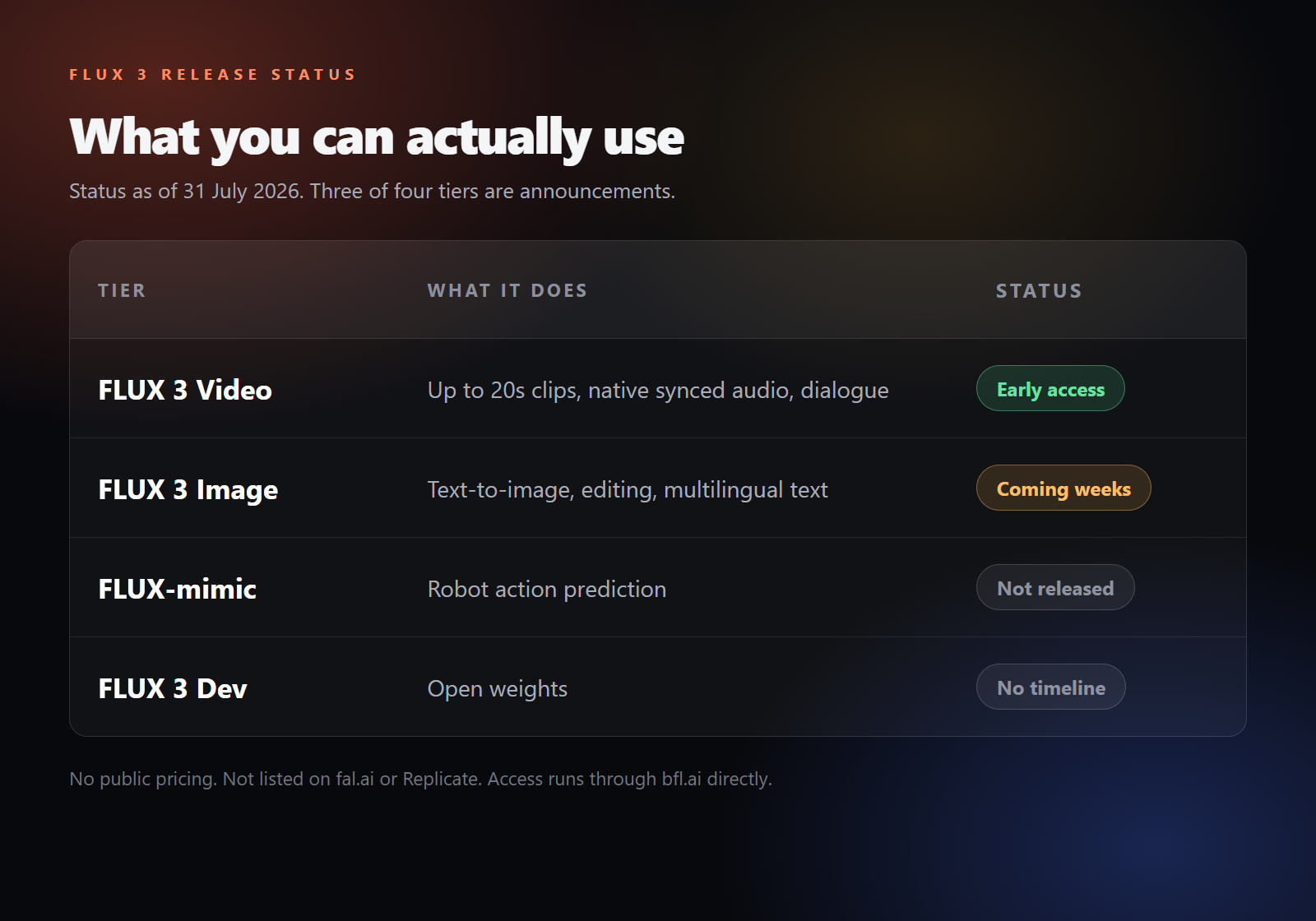
FLUX 3 Video is the only tier anyone outside BFL can touch, and it is behind an early access request at bfl.ai/models/flux-3. The confirmed capabilities are clips up to 20 seconds, native synchronized audio rather than a separate audio pass, multilingual dialogue, and four input modes: text, image, video, and keyframe conditioning. It also supports agentic chaining, where one generation feeds the next. Previews render at roughly 720p.
FLUX 3 Image is the tier most readers of this site care about, and it is not out. BFL says it is coming in the following weeks and promises better handling of complex multi-part prompts, high-accuracy multilingual text rendering inside images, and editing that holds up across styles and aspect ratios. Those are claims from the announcement post, not measured results. Treat them as a roadmap.
FLUX-mimic targets robotics rather than content work. FLUX 3 Dev is the open weights line, which historically arrives after the hosted tiers, with no stated date this time.
FLUX 3 video quality against other models
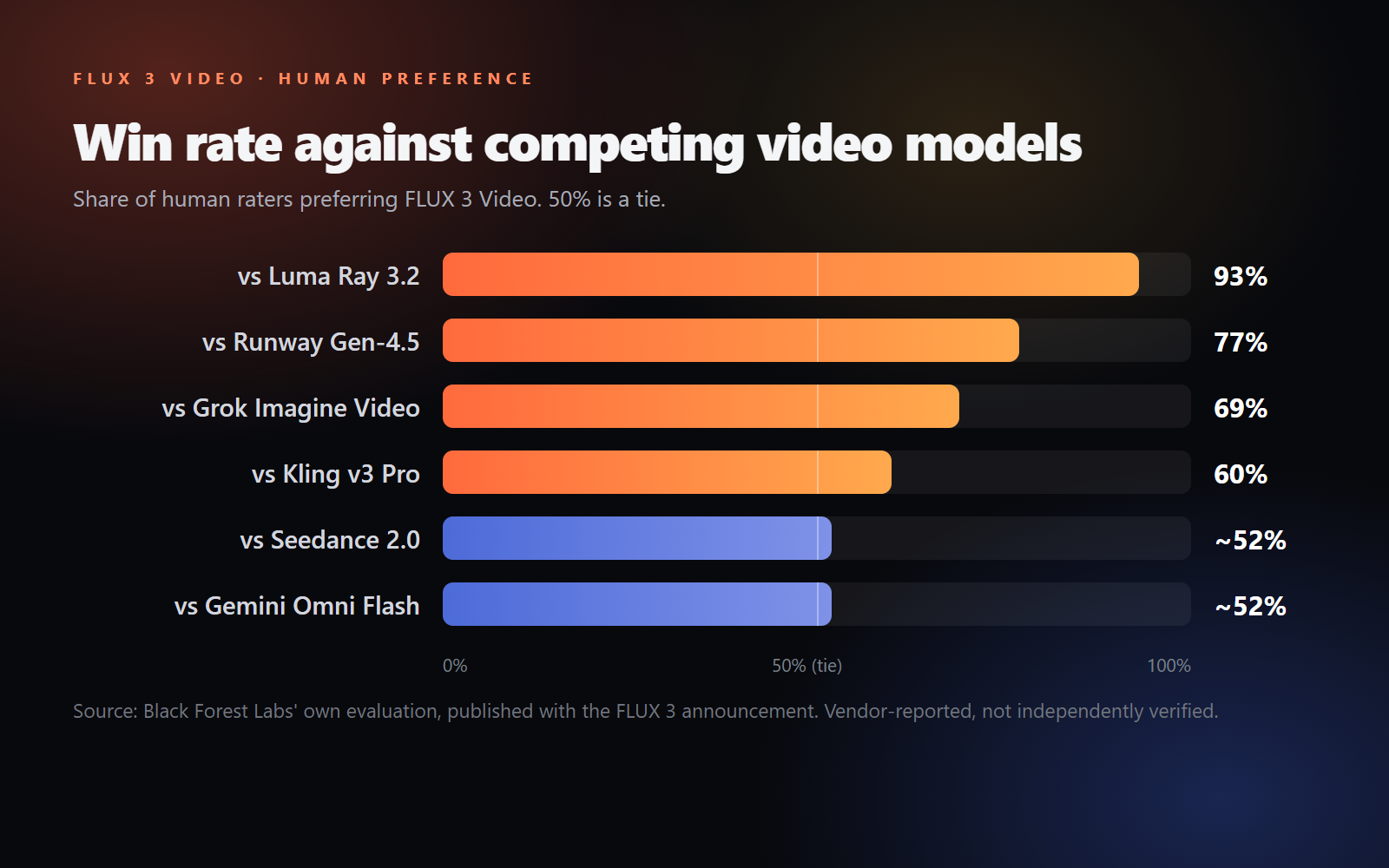
BFL published human preference win rates for FLUX 3 Video against the current field. These are the vendor’s own numbers from their own evaluation, so read them as a directional claim rather than an independent benchmark.
| Compared against | FLUX 3 Video preferred |
|---|---|
| Luma Ray 3.2 | 93% |
| Runway Gen-4.5 | 77% |
| Grok Imagine Video | 69% |
| Kling v3 Pro | 60% |
| Seedance 2.0 | ~52% |
| Gemini Omni Flash | ~52% |
The shape of that list is more informative than any single number. FLUX 3 Video wins decisively against the older or lighter video models and lands in a near tie with the two current frontier systems. A 52% preference rate is a coin flip, so on quality alone FLUX 3 Video is competitive at the top rather than ahead of it. The differentiator is the feature set: 20 second clips with dialogue and synchronized audio generated in one pass is not something every competitor offers.
Pricing and access for FLUX 3
There is no public pricing for FLUX 3. BFL has not published per-second or per-generation rates for the video tier, and since FLUX 3 Image has not shipped, there is nothing to price there either.
Access is also narrower than previous launches. FLUX 3 is not on fal.ai or Replicate, which is where most FLUX pipelines source their inference. That means the aggregator route that works for the rest of the family does not work here yet. If your workflow depends on a hosted provider rather than BFL directly, you are waiting regardless of whether your early access request is approved.
For anything you need to ship this month, the existing FLUX endpoints are still the practical answer. The FLUX Pro API pricing and code examples page covers current rates and request shapes for the tiers that are generally available.
If you are trying to decide whether to hold a project for the new release or build now, it is worth reading what changed between FLUX 3 and FLUX 2 before committing, because the answer depends on whether you need video and audio or just better images.
What FLUX 3 means for existing FLUX pipelines
Nothing breaks. FLUX 2 endpoints keep working, and FLUX 3 is a separate model family rather than a drop-in replacement. If you already call FLUX from code, the curl and Python request patterns for FLUX 2 remain valid.
The changes worth planning for are structural rather than syntactic:
- Audio becomes part of the generation, not a post step. If your pipeline currently generates video and then attaches a voiceover or soundtrack, a model producing synchronized audio inline removes a stage and also removes your control over that stage.
- Longer clips change the edit. Twenty seconds is long enough to hold a full scene, which shifts the work from stitching four second fragments to directing one continuous shot.
- Text rendering may stop being a workaround. Teams currently composite text over generated images because diffusion models mangle typography. If FLUX 3 Image delivers on multilingual text accuracy, that compositing step gets shorter.
- Keyframe conditioning is the interesting input. Text-to-video is the demo, but feeding a start and end frame is what makes output repeatable for brand work.
None of that is worth rewriting a working pipeline for until the tier you need is actually available. The reasonable move is to request early access, keep shipping on FLUX 1.1 Pro or FLUX 2 for images, and revisit when FLUX 3 Image lands.
FLUX 3 FAQ
Is FLUX 3 available to use right now?
Partly. FLUX 3 Video is in gated early access through bfl.ai/models/flux-3. FLUX 3 Image, FLUX-mimic, and FLUX 3 Dev are announced but not released.
When is FLUX 3 Image coming out?
Black Forest Labs said “coming weeks” in the July 23 announcement without giving a date. There is no confirmed release day.
How much does FLUX 3 cost?
BFL has not published pricing for any FLUX 3 tier. Early access is request based, and no per-generation rates have been announced.
Can I run FLUX 3 on fal.ai or Replicate?
Not yet. FLUX 3 is not listed on either platform. Access currently runs through Black Forest Labs directly.
How long can FLUX 3 videos be?
Up to 20 seconds, with native synchronized audio and multilingual dialogue in the same generation. Previews are around 720p.
Will FLUX 3 have open weights?
BFL has announced a FLUX 3 Dev tier with open weights but has not given a timeline. Previous Dev releases followed the hosted tiers rather than launching alongside them.
Should I switch from FLUX 2 to FLUX 3?
For images there is nothing to switch to yet. For video with audio, FLUX 3 Video is worth requesting access to, but the vendor’s own numbers put it level with Seedance 2.0 and Gemini Omni Flash rather than clearly ahead, so it is a feature decision more than a quality one.
The short version
FLUX 3 is a real architectural change and a partial release. The video tier exists, performs well against the field, and is gated. The image tier that most FLUX users are waiting for is an announcement with a vague date attached. There is no pricing, and no aggregator access.
The honest read: request early access if video with synchronized audio is on your roadmap, and otherwise keep building on the FLUX tiers that are generally available today. When FLUX 3 Image ships with real numbers behind it, that is the point to reassess.